
Animation History: From Early Experiments to Modern Era
Freya Thackeray · on 30 July 2026 · 7 min read · Last reviewed 30 July 2026
Animation history traces the evolution of moving images from early experiments in the late 19th century to the digital masterpieces of today.
At its heart, animation history is a story of relentless innovation, driven by pioneers who transformed simple sketches and photographs into the vibrant, dynamic art form we know today.
- The earliest known animation, Roundhay Garden Scene (1888), is a brief stop-motion film shot by Louis Le Prince.
- French artist Émile Cohl created the first fully animated film, Fantasmagorie (1908), using hand-drawn techniques.
- Walt Disney’s Steamboat Willie (1928) introduced synchronized sound and popularized Mickey Mouse.
- The Golden Age of Animation (1920s-1960s) saw the rise of iconic studios like Disney, Warner Bros., and Fleischer Studios.
The oldest animation in history
The oldest known animation is Roundhay Garden Scene (1888), a brief stop-motion film shot by Louis Le Prince using his single-lens camera. This 2.11-second clip features Le Prince’s family members in motion, capturing the essence of early animation.
While rudimentary by today’s standards, Roundhay Garden Scene laid the groundwork for future developments in animation, demonstrating the potential of moving images. The film’s discovery in the late 20th century cemented its place as a milestone in animation history.
The history of animation timeline
The history of animation can be divided into distinct eras, each marked by technological advancements and artistic innovations.
| Era | Key Developments | Notable Works |
|---|---|---|
| Early Experiments (1888-1914) | Stop-motion, flip books, and hand-drawn techniques. | Roundhay Garden Scene (1888), Fantasmagorie (1908). |
| Silent Era (1914-1927) | Introduction of cell animation and character-driven storytelling. | Gertie the Dinosaur (1914), Alice Comedies (1923-1927). |
| Golden Age (1928-1960s) | Sound synchronization, color animation, and feature-length films. | Steamboat Willie (1928), Snow White and the Seven Dwarfs (1937). |
| Television Era (1960s-1980s) | Limited animation, television series, and merchandising. | The Flintstones (1960-1966), Scooby-Doo (1969-1970). |
| Digital Era (1980s-Present) | Computer-generated imagery (CGI), 3D animation, and streaming platforms. | Toy Story (1995), Spirited Away (2001), Avatar: The Way of Water (2022). |
How was animation done in the 1930s?
In the 1930s, animation was primarily created using hand-drawn techniques on celluloid sheets, a method known as cel animation. Animators would draw each frame on transparent celluloid sheets, which were then layered over static backgrounds and photographed to create the illusion of movement.
Studios like Walt Disney Productions perfected this technique, introducing innovations such as synchronized sound (Steamboat Willie, 1928) and Technicolor (Flowers and Trees, 1932). The 1930s also saw the development of character arcs, complex storylines, and special effects like the multiplane camera, which added depth to animated scenes.
What is the old style of animation called?
Old style animation is traditionally known as traditional animation or hand-drawn animation. This technique involves drawing each frame by hand on paper or celluloid sheets, which are then photographed and played in sequence to create the illusion of movement.
Hand-drawn animation dominated the industry from the early 20th century until the rise of computer-generated imagery (CGI) in the late 20th century. Studios like Disney, Warner Bros., and Fleischer Studios pioneered this style, producing iconic works such as Snow White and the Seven Dwarfs (1937) and Looney Tunes (1930-1969).
What was the first animation in history?
Fantasmagorie (1908), created by French artist Émile Cohl, holds the title of the first animation in history. This short film is considered the first fully animated work, featuring a stick-figure character moving through a surreal world filled with changing objects and playful transformations.
Fantasmagorie showcased techniques like frame-by-frame animation, double exposure, and on-screen drawing, setting the stage for future developments in the field. The film’s playful and experimental nature captured the imagination of early audiences and inspired generations of animators.
Major studios in animation history
Several major studios have shaped the trajectory of animation history, each contributing unique techniques and iconic works. The Golden Age of Animation saw the rise of studios like Disney, Warner Bros., and Fleischer Studios, which dominated the industry with innovative storytelling and groundbreaking technology.
| Studio | Founded | Notable Works |
|---|---|---|
| Walt Disney Productions | 1923 | Snow White and the Seven Dwarfs (1937), Bambi (1942), The Lion King (1994). |
| Warner Bros. Animation | 1933 | Looney Tunes (1930-1969), Merrie Melodies (1931-1969), Space Jam (1996). |
| Fleischer Studios | 1921 | Koko the Clown (1924-1929), Popeye the Sailor (1933-1957), Superman (1941-1943). |
| Paramount Pictures | 1912 | Famous Studios (1942-1967), Little Lulu (1943-1948), Herman and Katnip (1945-1959). |
Walt Disney Productions and the Golden Age of Animation
Walt Disney Productions played a pivotal role in the Golden Age of Animation, setting industry standards with groundbreaking techniques and timeless stories. The studio’s first full-length animated feature, Snow White and the Seven Dwarfs (1937), was a monumental achievement that demonstrated the potential of animation as a narrative art form.
Mickey Mouse, Donald Duck, and Goofy debuted during the Golden Age of Disney, becoming cultural symbols and enduring favorites. Innovations such as the multiplane camera (The Old Mill, 1937) and Technicolor (Flowers and Trees, 1932) enhanced the visual quality of Disney’s films, pushing the boundaries of animation.
Early history of animation
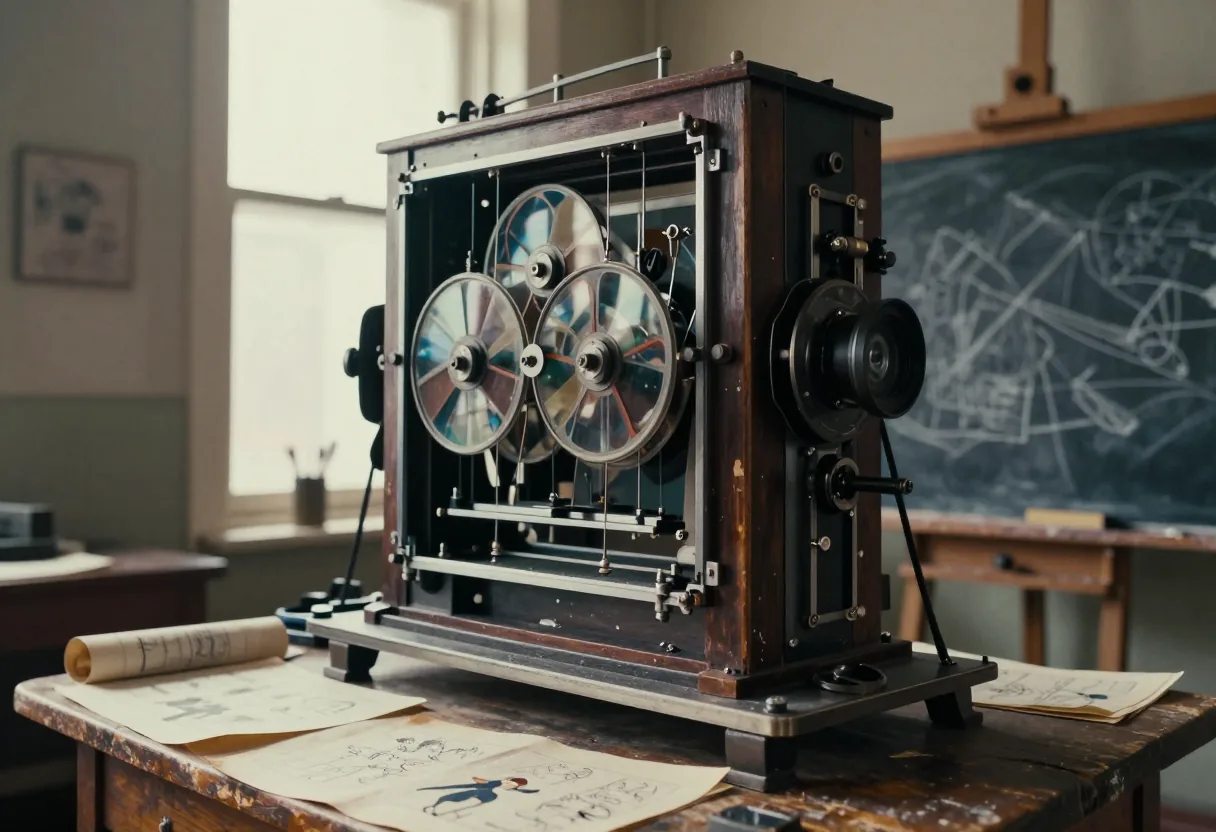
Animation’s early history is a fascinating journey through ingenious experiments and pioneering techniques. From the earliest flip books and zoetropes to the first hand-drawn animations, this period laid the foundation for the art form we know today.
A spinning zoetrope, the first known animation device, dates back to the 19th century. Invented by William George Horner in 1834, the zoetrope used a spinning cylinder with slits to create the illusion of movement from a series of static images. This principle was later refined in devices like the praxinoscope and the flip book, which became popular forms of entertainment.
Film-based animation began in the late 19th century, marking a transition from mechanical devices, thanks to pioneers like Louis Le Prince and Émile Cohl. Le Prince’s Roundhay Garden Scene (1888) and Cohl’s Fantasmagorie (1908) marked the beginning of cinematic animation, paving the way for future innovations.
The Wartime Era of Disney
During the Wartime Era, Walt Disney Productions contributed significantly to the war effort by creating educational and propaganda films. These films combined entertainment with critical messages, reaching audiences both at home and abroad.
A standout instance is Victory Through Air Power (1943), a movie promoting strategic bombing as a way to achieve victory. Disney’s animation skills were used to break down intricate military ideas, presenting them clearly to the public. During this time, the studio also created training films for the military, demonstrating its adaptability and dedication to supporting the war.
Old classic cartoons list
Old classic cartoons hold a special place in animation history, capturing the imagination of generations with their timeless humor and creativity. These early works laid the groundwork for modern animation, introducing iconic characters and innovative techniques.
- Steamboat Willie (1928) – Introduced Mickey Mouse and synchronized sound.
- Silly Symphonies (1929-1939) – A series of musical shorts featuring innovative animation.
- Looney Tunes (1930-1969) – Featured iconic characters like Bugs Bunny and Daffy Duck.
- Popeye the Sailor (1933-1957) – Created by Fleischer Studios, popularized the spinach-eating sailor.
- Snow White and the Seven Dwarfs (1937) – Disney’s first full-length animated feature.
Golden age of cartoons 2000s
Studios like Pixar, DreamWorks, and Studio Ghibli pushed the boundaries of animation, creating visually stunning and emotionally resonant films. The Golden Age of Animation saw a resurgence in the 2000s, with a renewed interest in hand-drawn techniques and a focus on storytelling.
Pixar’s Toy Story (1995) started the CGI era, while DreamWorks’ Shrek (2001) blended humor and heart to attract all ages. Studio Ghibli’s Spirited Away (2001) displayed the charm of hand-drawn animation, gaining praise and awards. These films entertained and advanced the art, proving its storytelling power.
This era celebrated the rich history of animation while paving the way for future innovations. The Golden Age of Animation in the 2000s also saw the rise of streaming platforms, making classic and contemporary animations more accessible than ever.
In my experience, looking at the history of animation shows a mix of creativity, resilience, and innovation. Each period introduces new techniques and stories, enhancing the art form and motivating future animators.
Frequently asked questions
Who created the first recorded animated film?
French artist Émile Cohl made *Fantasmagorie* in 1908, a 1-minute film with 700 drawings. It’s considered the first fully animated film, though earlier experiments like *Humorous Phases of Funny Faces* (1906) by J. Stuart Blackton existed. Cohl’s work set early standards for hand-drawn animation.
How did Disney revolutionize animation in the 1930s?
Disney introduced synchronized sound in *Steamboat Willie* (1928) and Technicolor in *Flowers and Trees* (1932). *Snow White and the Seven Dwarfs* (1937) became the first feature-length animated film, proving animation as viable for long narratives. Disney’s use of storyboards and multiplane cameras advanced technical precision.
When did computer animation begin influencing mainstream films?
Early computer-generated imagery (CGI) appeared in *Futureworld* (1976) and *Tron* (1982). Pixar’s *The Last Dinosaur* (1985) short demonstrated photorealistic potential. CGI broke through with *Jurassic Park* (1993), blending live-action with digital effects. Pixar’s *Toy Story* (1995) proved full-length CGI animation was commercially viable.
Which animation technique was pioneered in *Gertie the Dinosaur* (1914)?
Winsor McCay’s *Gertie the Dinosaur* introduced keyframe animation, where crucial frames are drawn and in-between frames are filled later. This method became foundational for efficiency in animation production. McCay also used registration pegs to stabilize drawings, improving consistency across frames.
Frequently asked questions (in practice)
Who created the first animated film?
French artist Émile Cohl made the first animated film, 'Fantasmagorie,' in 1908. Using stop-motion techniques, he drew 700 images on paper, creating a surreal, dreamlike sequence. This 1-minute film set the stage for future animation experiments.
What was the first animated feature film?
Disney's 'Snow White and the Seven Dwarfs' premiered in 1937, becoming the first full-length animated feature. It took three years to produce, with 750,000 drawings. The film's success proved animation could tell complex stories and attract adult audiences.
How did World War II impact animation?
During WWII, Disney shifted focus to producing propaganda films and training videos for the military. This period saw innovation in animation techniques, but fewer feature films were released. Post-war, studios like Warner Bros. gained prominence with their animated shorts.
What technological advance revolutionized animation in the 1990s?
Computer-generated imagery (CGI) transformed animation in the 1990s. Pixar's 'Toy Story' (1995) was the first fully CGI-animated feature. This technology allowed for 3D modeling, texturing, and rendering, creating a more immersive visual experience.
See also: Animation Timeline: Industry Growth and Shifts.
Related Reading
- Top 10 Best Animated Series: A Curated List
- Evolution of Cartoons: How Animation Changed Over Decades
- Fascinating Animation Facts You Need to Know
See also: Cartoonist and Animator: Roles in Classic Studios.
See also: Rhythm & Hues Studios: Legacy and Impact.