
Cartoonist and Animator: Roles in Classic Studios

Declan Whitfield · on 30 July 2026 · 9 min read · Last reviewed 30 July 2026
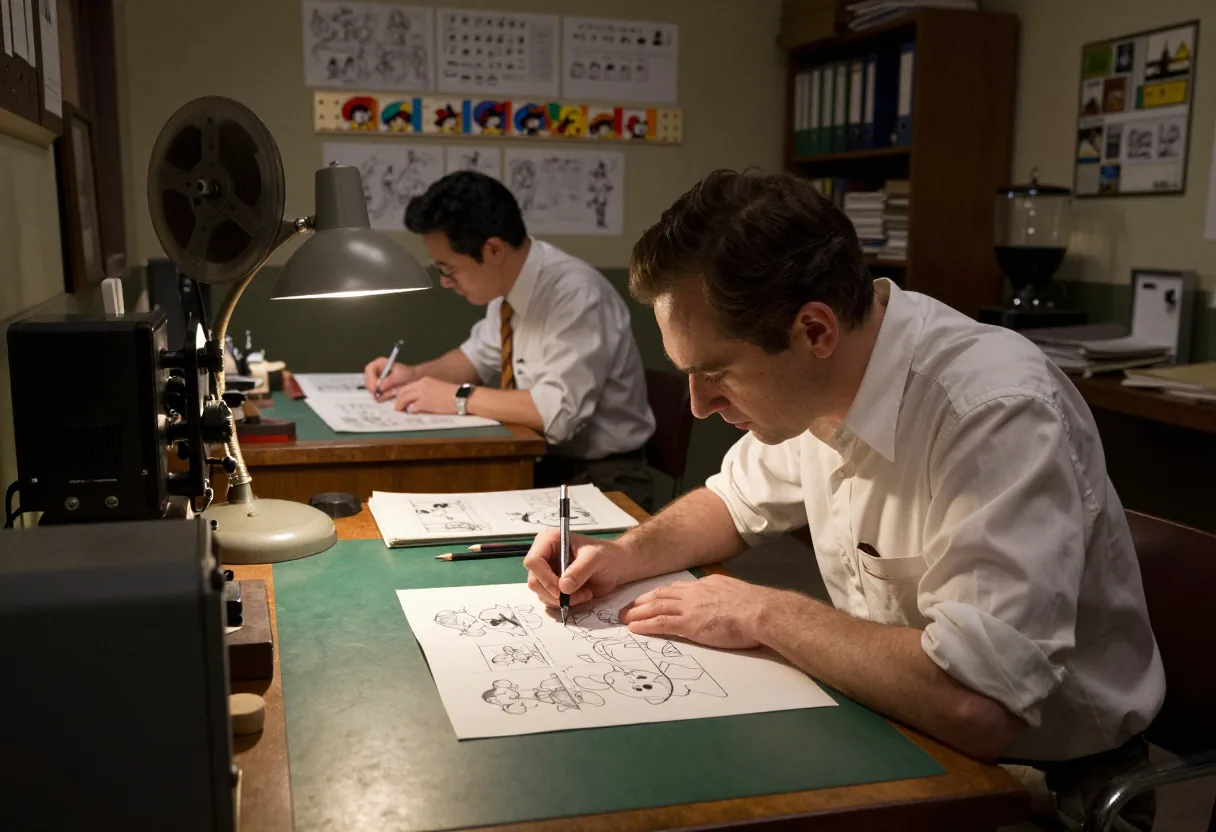
Cartoonist and animator roles in classic studios were distinct yet intertwined, with cartoonists sketching characters and stories while animators brought those drawings to life through movement.
This division of labour allowed vintage animation studios to produce iconic works efficiently, blending artistic vision with technical execution.
- The first animated feature film, Snow White and the Seven Dwarfs (1937), took three years to complete and involved 600,000 frames.
- Disney’s Multiplane Camera, used for Snow White and later films, created depth by layering up to 7 glass panes.
- Fleischer Studios’ Rotoscope technique traced live-action footage frame by frame to achieve lifelike movement, as seen in Gulliver’s Travels (1939).
- Walt Disney Productions employed over 500 animators at its peak during the 1940s, producing both films and wartime propaganda shorts.
The oldest animation in history
The oldest known animation is Humorous Phases of Funny Faces, created by J. Stuart Blackton in 1906.
This short film combined drawn animation with live-action sequences, marking a pivotal moment in the evolution of animated storytelling.
The film’s innovative techniques, such as drawing directly on blackboards and using stop-motion to manipulate sketches, laid the groundwork for future animators.
According to the Library of Congress, Blackton’s work is a cornerstone of early animation history.
How was animation done in the 1930s?
In the 1930s, animation was produced using a painstaking process called cel animation, where each frame was drawn on transparent sheets called cels.
Animators worked in studios like Walt Disney Productions and Fleischer Studios, where teams of artists divided tasks to create smooth movement.
For instance, in Snow White and the Seven Dwarfs (1937), Disney animators used the Multiplane Camera to achieve depth, layering up to 7 glass panes with painted characters and backgrounds.
A three-dimensional effect was created with this technique, revolutionising the industry.
What is the old style of animation called?
Old style animation is known as traditional or hand-drawn animation.
Drawing each frame by hand on paper or cels involved a technique that dominated the industry from the early 20th century until the rise of computer animation in the late 1990s.
Classic examples include Disney’s Snow White and the Seven Dwarfs (1937) and Fleischer Studios’ Popeye cartoons, which featured intricate hand-drawn characters and backgrounds.
Traditional animation remains influential, with studios like Rhythm & Hues occasionally revisiting the technique for nostalgic appeal.
What was the first animation in history?
Humorous Phases of Funny Faces, created by J. Stuart Blackton in 1906, is the first animation in history. Stuart Blackton** in 1906.
Combining drawn animation with live-action sequences, the pioneering work set the stage for future developments in the field.
Blackton’s techniques, such as drawing directly on blackboards and using stop-motion to manipulate sketches, were groundbreaking for the time.
According to the Library of Congress, Humorous Phases of Funny Faces is a critical milestone in animation history.
Vintage animation history timeline
A vintage animation history timeline spans from the late 19th century to the mid-20th century, encompassing key innovations and milestones.
The timeline begins with early experiments like Humorous Phases of Funny Faces (1906) and progresses through the Golden Age of Animation, which saw the rise of major studios like Walt Disney Productions and Fleischer Studios.
The Multiplane Camera, introduced by Disney in 1937 for Snow White and the Seven Dwarfs, revolutionised the industry by adding depth to animated films.
During the Wartime Era, studios like Disney contributed to propaganda efforts, producing shorts that combined entertainment with educational messages.
| Era | Key Innovations | Notable Works |
|---|---|---|
| Early Experiments (1900s-1920s) | Hand-drawn animation, stop-motion | Humorous Phases of Funny Faces (1906), Gertie the Dinosaur (1914) |
| Golden Age (1930s-1950s) | Cel animation, Multiplane Camera | Snow White and the Seven Dwarfs (1937), Fantasia (1940) |
| Wartime Era (1940s) | Propaganda shorts, combined techniques | Disney’s wartime shorts, Der Fuehrer’s Face (1943) |
History of animation timeline
A history of animation timeline traces the evolution of animation from its early beginnings to the modern era.
The timeline starts with Humorous Phases of Funny Faces (1906) and includes milestones like the introduction of sound in Steamboat Willie (1928) and the advent of colour in Flowers and Trees (1932).
During the Golden Age, studios like Walt Disney Productions and Fleischer Studios dominated the industry, producing iconic works such as Snow White and the Seven Dwarfs and Gulliver’s Travels.
The timeline also covers the rise of television animation in the 1950s and 1960s, with shows like The Flintstones and Scooby-Doo becoming cultural phenomena.
| Era | Key Innovations | Notable Works |
|---|---|---|
| Early Experiments (1900s-1920s) | Hand-drawn animation, sound | Humorous Phases of Funny Faces (1906), Steamboat Willie (1928) |
| Golden Age (1930s-1950s) | Colour, cel animation | Snow White and the Seven Dwarfs (1937), Gulliver’s Travels (1939) |
| Television Era (1950s-1960s) | Limited animation, TV series | The Flintstones (1960), Scooby-Doo (1969) |
Old classic cartoons list
An old classic cartoons list includes iconic works from the Golden Age of Animation, such as Snow White and the Seven Dwarfs (1937) and Fantasia (1940).
These cartoons were produced by major studios like Walt Disney Productions and Fleischer Studios, showcasing innovative techniques like cel animation and the Multiplane Camera.
Other notable entries include Gulliver’s Travels (1939) by Fleischer Studios, which used the Rotoscope technique to achieve lifelike movement.
These cartoons remain influential, with many being preserved and celebrated by institutions like the Library of Congress.
Early history of animation
Stuart Blackton** explored the possibilities of moving images. The early history of animation began with experiments in the late 19th and early 20th centuries, as pioneers like **J.
Blackton’s Humorous Phases of Funny Faces (1906) is considered the first animated film, combining drawn animation with live-action sequences.
During this period, animators developed techniques like hand-drawn animation and stop-motion, laying the foundation for future innovations.
The early history of animation also includes works like Gertie the Dinosaur (1914) by Winsor McCay, which showcased the potential of animation as a storytelling medium.
The Golden Age of Disney
The Golden Age of Disney spanned from the late 1920s to the early 1960s, during which the studio produced some of its most iconic works.
Sound marked the beginning of this era with Steamboat Willie (1928), continuing through Snow White and the Seven Dwarfs (1937), the first animated feature film.
During this period, Disney animators developed innovative techniques like the Multiplane Camera, which added depth to animated films.
The Golden Age also saw the creation of beloved characters like Mickey Mouse and Donald Duck, who became cultural icons.
Major studios
Major studios like Walt Disney Productions, Fleischer Studios, and Paramount Pictures played pivotal roles in the development of animation.
Walt Disney Productions, founded by Walt Disney and Roy O. Disney in 1923, revolutionised the industry with films like Snow White and the Seven Dwarfs and Fantasia.
Fleischer Studios, established by Max Fleischer and Dave Fleischer, was known for its Rotoscope technique and iconic characters like Popeye.
Paramount Pictures, through its subsidiary Famous Studios, produced popular cartoons like Little Lulu and Casper the Friendly Ghost.
Walt Disney Productions
Walt Disney Productions, founded in 1923, is one of the most influential animation studios in history.
The studio gained fame with the introduction of Mickey Mouse in Steamboat Willie (1928) and achieved a milestone with Snow White and the Seven Dwarfs (1937), the first animated feature film.
During the Golden Age, Disney animators developed innovative techniques like the Multiplane Camera, which added depth to films like Fantasia (1940).
The studio also contributed to wartime efforts, producing propaganda shorts like Der Fuehrer’s Face (1943).
Beginnings
Stuart Blackton and Émile Cohl experimented with moving images. The beginnings of animation trace back to the late 19th century, when pioneers like J.
Blackton’s Humorous Phases of Funny Faces (1906) is considered the first animated film, combining drawn animation with live-action sequences.
During this period, animators developed techniques like hand-drawn animation and stop-motion, laying the foundation for future innovations.
The beginnings of animation also include works like Gertie the Dinosaur (1914) by Winsor McCay, which showcased the potential of animation as a storytelling medium.
Mickey Mouse
Mickey Mouse, created by Walt Disney and Ub Iwerks in 1928, is one of the most iconic animated characters in history.
Mickey made his debut in Steamboat Willie, the first synchronized sound cartoon, which revolutionised the animation industry.
Over the years, Mickey has appeared in numerous films, TV shows, and merchandise, becoming a global symbol of Disney.
According to the Library of Congress, Mickey Mouse is a cultural icon that has endured for nearly a century.
Wartime Era of Disney
The Wartime Era of Disney spanned from the early 1940s to the end of World War II, during which the studio contributed to propaganda efforts.
Disney produced shorts like Der Fuehrer’s Face (1943), which combined entertainment with educational messages aimed at supporting the war effort.
During this period, the studio also faced financial challenges, leading to the release of more affordable package films like Saludos Amigos (1942) and The Three Caballeros (1944).
The Wartime Era showcased Disney’s ability to adapt to changing circumstances while maintaining its creative output.
Paramount Pictures
Paramount Pictures, through its subsidiary Famous Studios, played a significant role in the Golden Age of Animation.
Famous Studios produced popular cartoons like Little Lulu and Casper the Friendly Ghost, which aired on television in the 1950s and 1960s.
Paramount Pictures also distributed films from other animation studios, contributing to the widespread popularity of animated entertainment.
The studio’s influence extended beyond the Golden Age, with its cartoons remaining beloved classics.
Fleischer Studios
Fleischer Studios, established by Max Fleischer and Dave Fleischer, was known for its innovative techniques and iconic characters.
The studio introduced the Rotoscope technique, which traced live-action footage to achieve lifelike movement, as seen in Gulliver’s Travels (1939).
Fleischer Studios also created beloved characters like Popeye, who became a cultural icon through a series of popular cartoons.
The studio’s contributions to animation laid the groundwork for future innovations in the industry.
How to differentiate between cartoonist and animator roles
To differentiate between cartoonist and animator roles, understand that cartoonists sketch characters and stories, while animators bring those drawings to life through movement.
Cartoonists focus on creating the visual style and personality of characters, while animators specialise in the technical execution of movement and timing.
For example, in Snow White and the Seven Dwarfs (1937), cartoonists like Grumpy and Snow White were designed by artists, while animators brought these characters to life with fluid, expressive movements.
In my experience, recognizing how classic studios split up tasks shows the teamwork involved in animation production.
How to learn vintage animation techniques
To learn vintage animation techniques, study the works of classic studios like Walt Disney Productions and Fleischer Studios.
Explore resources like the Animation Archive's courses on London Animation Agencies, which offer insights into traditional animation methods.
Practice hand-drawn animation and experiment with techniques like the Rotoscope and Multiplane Camera to gain a deeper understanding of vintage animation.
Join communities of animators and artists to share knowledge and learn from experienced professionals.
Vintage animation history is a rich blend of innovation and creativity, shaped by the collaborative efforts of cartoonists and animators in classic studios. Knowing the distinct roles and techniques of these artists provides valuable insights into the evolution of animation.
Frequently asked questions
What distinguishes a cartoonist's role from an animator's in classic studios?
Cartoonists typically handle the initial creative process, designing characters, backgrounds, and storyboards. Animators bring these designs to life by creating movement frame-by-frame. The cartoonist's work is static, while the animator's is dynamic. Classic studios like Disney or Warner Bros. often had distinct teams for each role.
Which classic animation studios relied heavily on both cartoonists and animators?
Studios like Disney, Warner Bros., and Hanna-Barbera employed large teams of both cartoonists and animators. Disney, for example, had dedicated artists for character design and separate animators to bring Mickey Mouse or Snow White to life. Warner Bros. followed a similar model for Looney Tunes and Merrie Melodies.
How did the workflow between cartoonists and animators function in classic studios?
Cartoonists created the visual foundation, including sketches and storyboards. Animators then used these as blueprints to produce the actual motion. For instance, a cartoonist might design Bugs Bunny's mischievous expressions, while an animator would animate his movements and interactions. This division of labor ensured efficiency and consistency.
What tools and techniques did cartoonists and animators use in classic animation studios?
Cartoonists primarily used pencils, paper, and light tables. Animators employed techniques like the peg bar system and onion skinning to create smooth motion. Studios also used cameras to photograph each frame. This traditional approach was standard until digital tools began replacing manual processes in later decades.
Frequently asked questions (in practice)
What's the difference between a cartoonist and an animator?
Cartoonists create static images, often for newspapers, magazines, or webcomics. Animators bring drawings to life through motion, working in film, TV, or video games. Both rely on strong drawing skills, but animators need to understand timing, movement, and software tools like Maya or Toon Boom.
What tools do professional cartoonists use?
Professionals often use digital tablets like Wacom or iPad Pros with apps such as Procreate or Adobe Illustrator. Traditional tools include ink pens, brushes, and markers. Many cartoonists combine digital and analog techniques to refine their work.
How long does it take to animate a single episode of a TV cartoon?
It varies, but a typical 11-minute episode can take 6 to 8 months. Pre-production (storyboarding, scripting) takes 1-2 months. Production (animating, coloring, sound) takes 4-6 months. High-quality shows may take longer, especially with complex scenes or large teams.
Can cartoonists work in animation, and vice versa?
Absolutely. Many cartoonists transition into animation, bringing their unique styles to character design or storyboarding. Animators often contribute to cartooning, especially in concept art or visual development. Cross-discipline skills are highly valued in both fields.
Related Reading
- Software for Animation: Tools That Shaped the Industry
- Evolution of Cartoons: How Animation Changed Over Decades
- The Definitive Guide to Classic Animation Studios
- Animation History: From Early Experiments to Modern Era